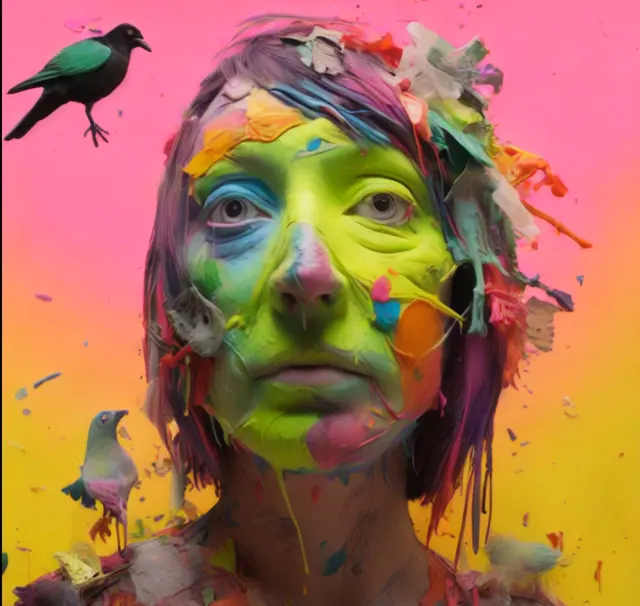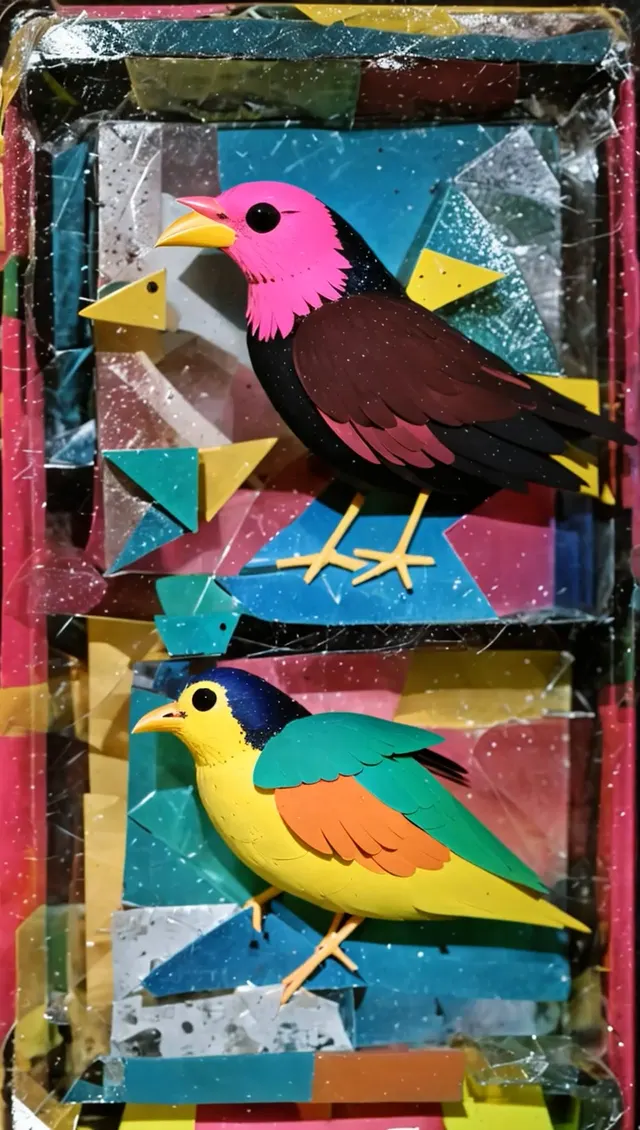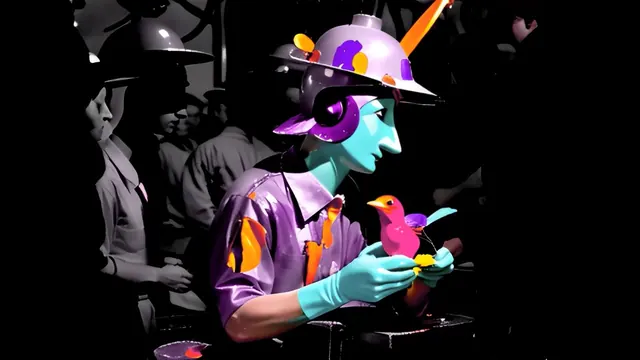
“The Past is Never Really Past” explores the complex interplay between humanity, technology, and the environment. The film creatively reimagines the lives of 1950s factory workers, 1960s Sony workers in Japan, and features an interview with sci-fi writer Arthur C. Clarke from the 1970s. It blends archival-style black-and-white footage with vivid, AI generated painted depictions of people and birds, using custom models. This visual contrast highlights the tension between historical Keynesian industrial ambitions and today’s post-Fordist technological advancements, marked by the rise of AI, which is displacing human labor in speed and efficiency.
Birds recur throughout the film as symbols of human creativity and our deep connection to nature. A bond that endures even within the realms of advanced technology and neoliberal capitalism.
It was 2024 and there was a piece of software called ComfyUI that allowed people to generate video with artificial intelligence and to see and adjust every stage of the process. Platforms such as Hugging Face and Civitai were crowded with shared models, and the many Discord channels that supported them were filled with conversations, experiments, and small discoveries.
I had been exploring artificial intelligence image making enthusiastically for almost two years by that point, but something in the wider culture of it had started to feel like a recursive loop. You would make an image in Midjourney, only to see something eerily similar appear days later in another person’s work. I imagine the same was true in the other direction, since the model folded every new contribution back into its enormous training set. I never felt real ownership over any of those generated pictures, and there was an odd sensation of being one part of a vast and untraceable engine. It began to resemble a form of self imposed productivist pressure and I found my interest evaporating.
ComfyUI felt different. It answered a technical curiosity and created a slower working rhythm that felt more like learning a craft. I spent long stretches experimenting and watching new developments appear almost daily.
Back when GPT first arrived and I was still using Google for most questions, I searched for its possible effect on employment and came across a set of predictions on the World Economic Forum site. They referred to the Creative Destruction theory proposed by Joseph Schumpeter, in which new inventions continually sweep away older industries and practices, reshaping the entire economic landscape. The theory imagines a cycle in which new work emerges as old work disappears, and economic growth rises from that constant churn.
The theory dates from 1942, before the detonation of the atomic bomb in 1945 and before any broad understanding of the environmental costs of mass consumption. It belonged to a different moment entirely. That realisation sent me into a steady drift through archival footage from the middle of the twentieth century. I began to rework old factory reels and assembly lines, using ComfyUI to nudge them into another register. Robot arms moved with choreographed precision, workers faded from the frame, and the films became small meditations on labour, disappearance, and the desire to automate the world.
Around this time I also found myself looking closely at birds. Perhaps because they feel delicate yet persistent, or because they occupy an older rhythm. They often appear at the edges of things, looking through our windows while we type and click our way through a crazily accelerated moment in time.
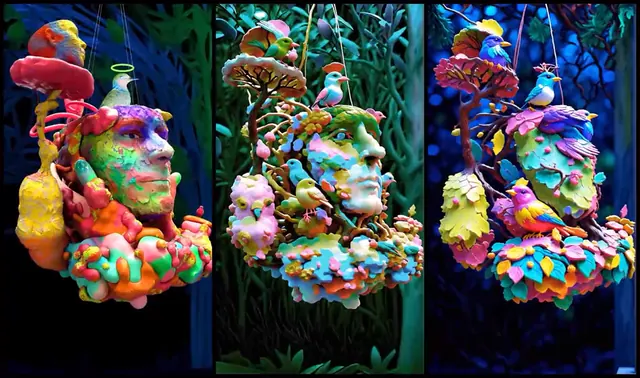
The Offline Feed interrogates the growing dissonance between our digital lives and our innate need for physical, natural experiences. Inspired by the social media trend of ‘Life Hacks,’ this work critiques the paradox of using technology to mediate our engagement with the world, a contradiction especially evident in the proliferation of apps designed to reduce screen time.
By imagining a life hack that transforms human heads into bird feeders, this piece explores the absurdity of attempting to reconcile our need for nature within increasingly digital confines. The human head, derived from a 3D scan of my partner, serves as a symbol of the individual caught between these two worlds. Surrounded by elements of indoor life, it underscores the tension between our constructed environments and the organic world we long to reconnect with.
The use of video-to-video animated diffusion in ComfyUI further abstracts the subject, creating iterations that increasingly distance the work from its original form. This process reflects the progressive detachment from our physical realities as we become more enmeshed in digital environments, questioning whether our attempts to integrate nature into our tech-driven lives are ultimately futile.
In this series, the bird feeder head becomes a metaphor for our fragmented existence, simultaneously rooted in the physical world but increasingly alienated from it by the tools meant to connect us.